One suitcase,
no schedule,
receipts kept in.
Honest, slow, solo travel films from South Korea, Japan and China. Long stays, cheap rooms, local buses. No drone montages, no places you MUST see before you die.



South Korea
대한민국Where the journey started, and where I learned how far the kindness of strangers carries you. On my first night in Busan I met Jason, a stranger who let me stay in one of his empty apartments completely free — and that set the tone for two months.
Haeundae beach mornings, a Korean haircut, unwinding in what's said to be the biggest jjimjilbang in Asia, Seoul's 600-year-old hanok village lit up at night, and my 32nd birthday among the royal tombs of Gyeongju.
Japan
日本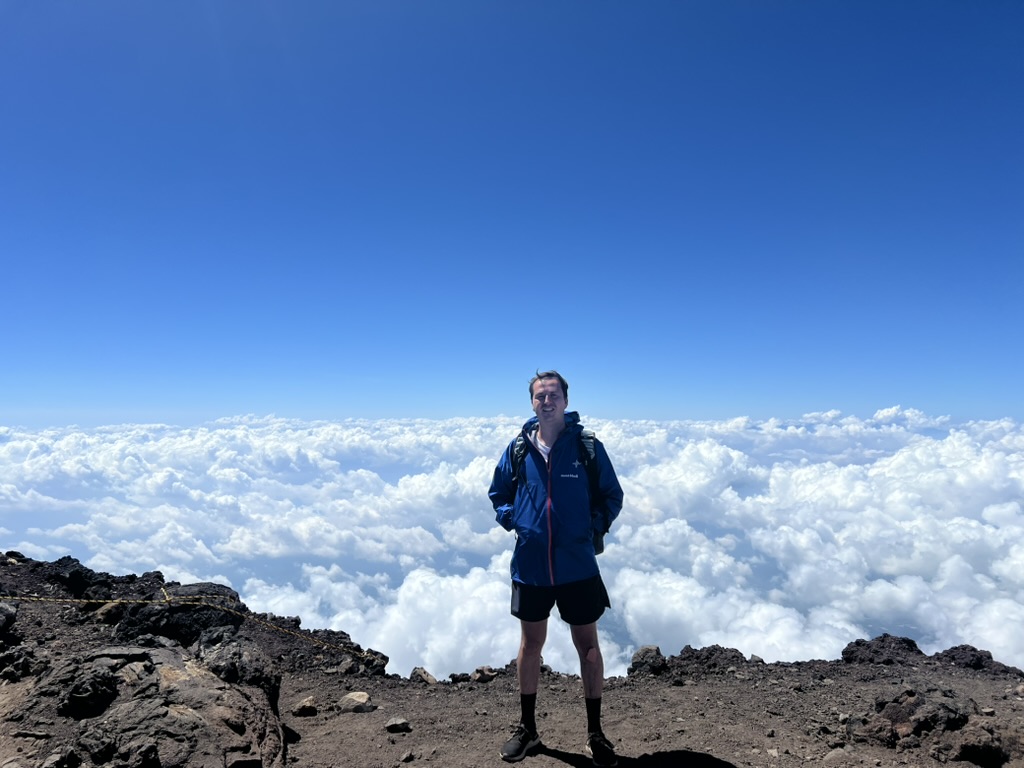
From Korea I set myself a slightly mad challenge: hitchhike the length of Japan — around 1,200 km from Fukuoka up to Tokyo, on a paper sign and a lot of faith in strangers.
Along the way: the hot springs of Beppu, Hiroshima's castle and Peace Museum, real A5 Kobe wagyu at the birthplace of teppanyaki, a Shiba Inu café in Kyoto, and climbing Mt Fuji — with the worst sunburn of my life to prove it.
China
中国My time in China began in Hong Kong, before heading on to Zhengzhou, the capital of Henan province — a place I'd lived years ago and made my base for the better part of a year.
Friends started flying out to join me; with my mate Ben I took the 300 km/h bullet train to Xi'an for a real bucket-list moment, the Terracotta Army. Then a month home for my sister's wedding, and now Hangzhou — where a lot of my Mandarin gets used in real time.
Is BucketListBrodie good for planning a trip to Korea, Japan or China?
Yes — it's aimed at travellers who want the honest, budget-conscious, longer-stay version: about two months in South Korea around Busan, hitchhiking the length of Japan, then China (Zhengzhou, Xi'an and the Terracotta Army), and now Hangzhou.
What kind of travel does it cover?
Solo, budget, slow and long-term travel across East Asia — living somewhere for weeks or months, using local transport, tracking real costs, and learning the language, rather than sprinting between sights.
How does he afford to travel long-term?
By keeping it cheap and slow, and through the kindness of people he meets. He sold his house and most of his belongings, travels with a single suitcase, and stays long enough to lower the daily cost. In Korea, Jason — a stranger he'd met his first night in Busan — even lent him an empty apartment for free.